
Added on 27 March 2023

Since the decision of the German Federal Labour Court of 13 September 2022, companies are obliged to use a working time recording system. For many companies, the question now is how to implement this regulation and how such a system can be integrated into the software structure of their company.
In this article, we provide an insight into how to integrate a time recording tool into a company's software landscape using Clockin as an example, so that they do not have to incur additional expenses due to in the company.
The advantages of time recording tools for companies
The use of time recording tools is becoming mandatory and companies fear a lot of effort with the integration of time recording tools into their system landscape. Nevertheless, there are also many advantages that these systems bring with them:
- Improved employee productivity:
Thanks to the avoidance of distractions through the manual recording of working hours, employees are more productive or can focus on more important things. This is because automated timekeeping reduces work interruptions and delays.
- Increased transparency:
Digital tracking of working time improves transparency. This avoids misunderstandings and conflicts, because the documentation of working hours is clear and unambiguous.
- Easy integration into existing software landscapes:
Time tracking tools can be seamlessly integrated into existing software systems, because the use of open APIs and standards avoids compatibility problems. Thanks to the use of platform independence and data validation, simplified data migration is ensured.
In this way, the integration of time recording systems also brings benefits for companies and their employees.
Challenges in integrating time tracking tools for companies
Despite the benefits, there are also challenges that companies face, but there are solutions for these as well:
- Additional effort
Somehow the data has to get from one system to the other.
Many companies generally have problems integrating new software systems into their existing IT landscape. The solution lies in the use of open APIs and standards to ensure connectivity and communication between different systems. This technology is also used by maesn for its integration platform to connect systems and enable a homogeneous IT landscape in companies.
- Data protection and security
By using digital time tracking tools, some companies fear problems regarding data protection and security of working time data. To address this, encrypted connections should be used and data should be stored in secure cloud systems, such as maesn is one, or on local servers.
- Cost
Implementing new systems raises concerns about high costs in many companies, and companies also fear a high investment when integrating time and attendance tools. Therefore, careful planning and budgeting should be done in advance, but also take into account that a time tracking tool can save a lot of time. Thus, depending on the case, it may be that a lot of working time and thus costs can be saved by integrating such a tool.
And so it becomes clear that although the challenges may seem great at first glance, they are very quickly nullified with the right software. Thus maesn offers a solution for the implementation of software systems in already existing IT landscapes, which means that many challenges do not arise in the first place.
The integration of time recording tools into a company's existing software landscape
The integration of time and attendance tools into a company's existing software landscape can be challenging, especially if the existing systems do not have appropriate interfaces or APIs. This usually results in manual activities and multiple entries of customer, employee or order data.
For this case, integration platforms can help to integrate a time tracking tool into an existing software landscape of a company. An integration platform is software that makes it possible to connect different applications and systems and exchange data between them. In this way, companies can seamlessly link their different systems and create automated workflows.
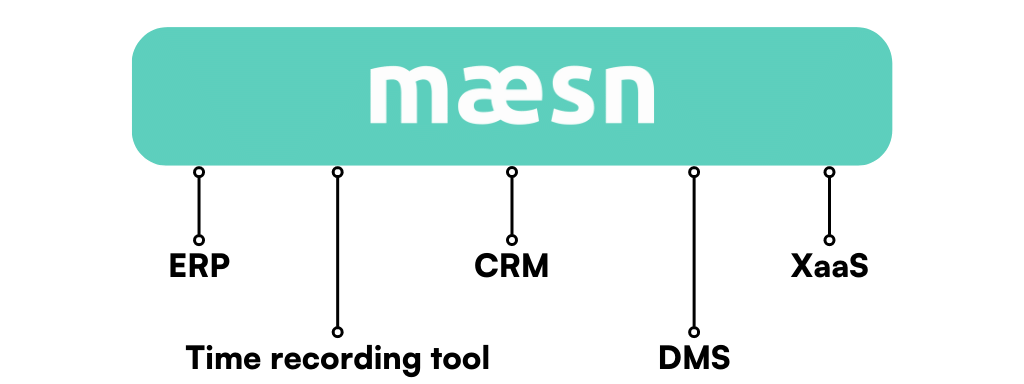
An integration platform can solve this challenge by acting as an intermediary between systems and enabling data exchange between them. Through standard connectors to the respective systems, integration with the desired workflows can be implemented in a rule-based manner. The connectors can facilitate the mapping of data fields between the different systems and accelerate the integration overall.
Furthermore, an integration platform can also help to increase security when integrating time and attendance tools, as it can have functions for data encryption and access control. This allows companies to ensure that the transferred data is secure and can only be viewed by authorised persons.
Overall, the use of an integration platform can help to facilitate the integration of time and attendance tools into an existing software landscape, improve workflow efficiency and increase data security.
Example of an integration of a time recording tool into an existing software landscape in a company
In order to explain such a process more clearly, we explain the integration of a time recording tool into an existing IT landscape of a company using a practical example. Here, the time recording tool ClockIn was linked to the ERP system Microtech.
The customer was faced with the challenge that order data from the ERP system had to be manually entered into the time recording tool. This led to unnecessary, repetitive work, as this step had to be carried out manually by employees on a regular basis.
The implementation was realised quickly. First, the workflow was defined so that for each new order in the ERP system, a corresponding twin should be created in the time recording system. After selecting the relevant data to be transferred and entering the login and password of the systems, all the basics were in place.
In this way, the two systems were linked so that all the data could be transferred from one system to the other without any problems. By using maesn, it was thus possible to integrate automation with the least amount of effort, saving time every day and dramatically reducing the error rate.